BAADER PLANETARIUM 2458275 Uhc Nebula Filter Telescope 1.25 FUHC-1
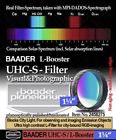
( Brand: Baader Planetarium ), ( Manufacturer Part Number: 2458275 ), ( Part Type: Filter ), ( Filter Type: Nebular ), ( Size: 1.25 In )
Review BAADER PLANETARIUM 1.25 Uhc Nebula Filter Telescope
The Baader Planetarium 1.25" UHC Nebula Filter (FUHC-1) is a must-have accessory for any serious astronomer or astrophotographer. This high-quality filter is specifically designed to enhance the visibility of nebulae and other deep-sky objects, making it easier to observe and capture stunning images of these celestial wonders.
The FUHC-1 filter is made of optical glass with a unique coating that blocks unwanted light pollution and increases contrast, allowing you to see fainter objects more clearly. It has a UHC (Ultrahigh Contrast) design, which means it is highly selective in the wavelengths it allows to pass through, filtering out light in the yellow and green spectrum to enhance the visibility of nebulae and other emission objects.
The filter has a 1.25" diameter, making it compatible with a wide range of telescopes and eyepieces. It is also multi-coated for maximum light transmission and minimal reflection, ensuring sharp and bright images. The filter is made of high-quality materials and is built to last, with a rugged aluminum frame and a scratch-resistant coating.
Whether you're a beginner looking to enhance your deep-sky viewing experience or an experienced astronomer looking to take your astrophotography to the next level, the Baader Planetarium 1.25" UHC Nebula Filter (FUHC-1) is an essential tool. With its ability to bring out the subtleties and details of nebulae, it will open up a whole new world of deep-sky exploration for you. So why wait? Add the Baader Planetarium FUHC-1 to your telescope accessory kit today and take your astronomy to new heights.
Pros of buying a Baader Planetarium 1.25 UHC Nebula Filter FUHC-1:1. Enhances Nebula and Emission Objects: This filter is specifically designed to enhance the visibility of nebulae and emission objects, making your deep-sky viewing experience more rewarding.
2. High Transmission: The filter has a high transmission rate, allowing as much light as possible to pass through it, which is crucial for faint deep-sky objects.
3. Narrowband Filter: The FUHC-1 is a narrowband filter, which means it only lets in specific wavelengths of light, reducing the interference from stars and other objects. This can help to bring out the details in nebulae.
4. Durable and High Quality: Baader Planetarium is known for its high-quality optics, and the FUHC-1 filter is no exception. It is made of high-density optical glass and has a multi-coated surface, ensuring clear and sharp images.
Cons of buying a Baader Planetarium 1.25 UHC Nebula Filter FUHC-1:1. Expensive: Compared to other filters, the Baader Planetarium FUHC-1 is quite expensive. This may not be within everyone's budget.
2. Narrowband Use Only: Since it is a narrowband filter, it can only be used for viewing nebulae and emission objects. If you are interested in other types of celestial bodies, you may need additional filters.
Conclusion:If you are a serious deep-sky enthusiast and are looking to enhance your viewing experience of nebulae and emission objects, the Baader Planetarium 1.25 UHC Nebula Filter FUHC-1 is a worthwhile investment. Its high transmission rate, narrowband properties, and high-quality optics make it a great tool for astrophotography as well. However, if you are on a tight budget or are interested in viewing a variety of celestial bodies, you may want to consider other filter options.
Recommendation:If you can afford the investment and are interested in deep-sky viewing, the Baader Planetarium 1.25 UHC Nebula Filter FUHC-1 is a great choice. It will significantly improve your viewing experience of nebulae and emission objects. If you are unsure, you may want to consider renting the filter first to test its performance and see if it meets your needs.
Details:
The combination of hardened coatings and fine optical substrate Baader uhc-s avoids this image degradation. Baader Planetarium uhc-s nebula filter excels at delivering a high-contrast and natural view of emission - without excessive dimming loss background star fields. Images will appreciate the broader pass band and inclusion of an extremely efficient h-alpha 656nm, as well extreme optical quality.
This translates to maximum image brightness and contrast. The result is a filter that imparts no image degradation, unlike other filters. Owners of smaller, telescopes will especially appreciate the high efficiency, and larger scope users love rich star fields detailed subtle nebular shadings that are left intact. The perfect filter for viewing emission nebula from light polluted skies, or boosting contrast of dark sky sites.
Sky background is darker, and contrast of emission nebulae are noticeably improved. Baader filters fulfill the requirements of an ideal filter - to perform their filtration at highest efficiency without any other detectable effect on image. In reality, high magnifications are very common and useful studying fine details, particularly for the brighter diffuse planetary nebulae. Most other uhc filters tend to excessively darken the sky and star fields, leaving nebulae looking artificial flat, set against an empty background.
At the heart of Baader uhc-s filters are their special fine optical substrate polishing process and advanced coating design. The Baader uhc-s manages to improve on contrast of typical broadband or so-called deep sky filters. The high transmission, sharp cutoffs, and more moderate 60nm pass band of Baader uhc-s filter retains a natural view, yet significantly boosts overall contrast. The advanced technology coatings enable filter to achieve an outstanding transmission of over 97 across entire pass band, with total blockage prominent light pollution lines.
Baader uhc-s filters can take high magnifications, and stars retain their pinpoint sharpness, even if the filter is used far ahead of image plane IE, for imaging use, or a star diagonal bonfire. To prevent deterioration from cleaning or exposure moisture, some other filters even resort sandwiching their delicate coatings between two layers of filter glass, resulting in potential blurred double images.
part #: 2458275 prices
- $22.79-$167.00
specifications telesfil:
- brand: Baader Planetarium
- mpn: 2458275
- part type: Filter
- filter type: Nebular
- size: 1.25 In
General telesfil:
- sky viewing > telescope filters
- in stock: Yes
- condition: Used
Ratings:
- Great communication. A pleasure to do business with. 08-31-18
- package arrived in super condition excellent seller and perfect communication;- 09-04-18
- Very Good! 08-31-18
- Good buyer, prompt payment, valued customer, highly recommended. 08-31-18
Seller telesfil:
- zipcode: 35079
- city: Hayden, Alabama
Payments telesfil:
- PayPal
Shipping telesfil:
- type: Flat
- cost: $0.0
- handling: 3 days
Offer telesfil:
- best offer: false
- min. bid: $59.00
- Started: September 9, 2018, 1:31 pm
- bids: 0
- : true
- quantity: 1
- Sold: 0
Returns telesfil:
- policy: no returns
Baader Planetarium 2458275 Is Similar To:
- 2458395 Baader Narrowband Iii Filter Nebula (55.1% similar) The Baader o-iii perfectly isolates two doubly ionized oxygen lines 496 and 501NM, through a very sharp narrow band pass 10 NM wide. To prevent deterioration from cleaning or exposure moisture, some other filters even resort sandwiching their delicate coatings between two layers of filter glass, ...(May 30th, 2018)
- 2408340 Baader Planetarium 1.25 Double (58.7% similar) Back to top and is plan optically polished. This can sometimes take 3-4 weeks to several countries. These are not included in the item price or shipping cost. The brightness is fully adjustable and can be adapted to both solar lunar observation. This can often change from batch to according the ...(September 28th, 2017)
- 2408342 Baader Planetarium 2 Single (62.9% similar) This 2 filter with M485X0. This permits a very convenient means of variably adjusting the image brightness, simply by using single polarizing filter between Herschel wedge and eyepiece. Filter to prevent damage the delicate internal layers of polarizing. Baader single polarising filter is a perfect ...(September 19th, 2017)
- 2408343 Baader Planetarium 1.25 Single (58.7% similar) These are not included in the item price or shipping cost. 25 filter with M28. Will combine the shipping weights and show you discounted cost. A particularly handy attribute of the Herschel wedge is its partial polarizing effect on solar image. 25 eyepieces directly. This can sometimes take 3-4 ...(July 21st, 2017)
- 2408344 Baader Planetarium 2 Double (60.7% similar) Manufacturer part number: or FPOL-2D. Will combine the shipping weights and show you discounted cost. Back to top this can often change from batch to according the whims of manufacturer. This can frequently take 4-6 weeks or more for several countries 8 Italy, Argentina, and south Africa Brazil. ...(August 28th, 2017)
- 2458276 Baader Planetarium Uhc-s Nebula 4047825009852 (61.7% similar) In reality, high magnifications are very common and useful studying fine details, particularly for the brighter diffuse planetary nebulae. Filter was purchased thru Astor-physics and thus arrived in different packaging than Baader. The perfect filter for viewing emission nebula from light polluted ...(November 8th, 2017)
- 2458291 Baader Planetarium 2 U Filter (70.3% similar) For the first time, amateurs can now record cloud structures on Venus. 75 thread male on one side and female the other. The filter cell has a standard M48X0. Given the poor transmissions of many optics in UV and lower sensitivity some CDs to this wave length , high filter efficiency complete ...(February 9th, 2017)
- 2458295 Baader Planetarium 1.25 Methane Narrowband (57.7% similar) Permanent damage to your retina and blindness can result. Also, since the human eye cannot see wave lengths above 700NM this filter is of no value for visual observing - won detect any difference. Other gaseous planets such as Neptune and Uranus can be effectively imaged with this filter. The disc ...(March 3rd, 2017)
- 2458300 Baader Planetarium Premium Eyepiece Filter Set Of Color Filters (64% similar) Will combine the shipping weights and show you discounted cost. Carefully designed spectral characteristics. Only one filter is needed for benefiting. Or, combine with any of the other Baader filters for interesting possibilities. No reduction in sharpness, even at high magnifications or when using ...(May 1st, 2018)
- 2458301 Baader Planetarium Premium Eyepiece Filter (63.5% similar) No reduction in sharpness, even at high magnifications or when using the filter far ahead of focal plane IE, digital imaging, front a diagonal bonfire. Back to top striae-free substrates are polished parallel to 30 seconds of avoid wedge errors. Carefully designed spectral characteristics. Baader ...(February 16th, 2017)
- 2458303 Baader Planetarium Premium Eyepiece Filter Blue Bandpass (62.7% similar) Freedom from ghost images, even when stacked. Back to top carefully designed spectral characteristics. For actual spectral traces, see color filter transmission curves. Baader Planetariums premium colored filters bring a new level of quality and performance to planetary contrast enhancement. Back to...(May 1st, 2018)