BAADER PLANETARIUM 2459282 Astrosolar Visual Solar Filter Film 50X100CM Roll
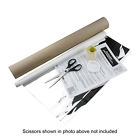
( Brand: Baader Planetarium ), ( Manufacturer Part Number: 2459282 ), ( Part Type: Film Filter )
Review BAADER PLANETARIUM 50x100cm Astrosolar Visual Solar Filter Film Medium Roll
The Baader AstroSolar Visual Solar Filter Film Roll, model number 2459282, is a high-quality solar filter designed specifically for safe and enjoyable solar observation. Measuring 50 centimeters by 100 centimeters, this filter roll provides a large viewing area, making it ideal for use with telescopes or binoculars.
This Baader AstroSolar filter is made from optical-quality polymer material, which is specifically engineered to block harmful solar radiation while allowing safe viewing of the sun's visible light spectrum. The filter has a dense aluminum oxide coating, which provides a high optical density of 5.0, ensuring that it effectively blocks up to 100,000 times more sunlight than unfiltered light.
The Baader AstroSolar filter is designed to be easy to use, with a self-adhesive backing that allows it to attach securely to your telescope or binocular lens. It is also highly resistant to scratching and tearing, ensuring that it will last for many observing sessions.
The filter roll comes in a protective storage tube, which helps to keep it clean and free from dust and debris when not in use. The filter is also designed to be reusable, making it a cost-effective option for extended solar observation.
Overall, the Baader AstroSolar Visual Solar Filter Film Roll is a must-have accessory for any serious solar observer. Its large size, high optical density, and easy-to-use design make it an excellent choice for safe and enjoyable solar viewing. With the Baader AstroSolar filter, you can safely observe the sun's surface, solar flares, and solar prominences, making for an unforgettable observing experience.
Pros of buying Baader Astrosolar Visual Solar Filter Film Roll (50x100cm, item number 2459282, Planetarium):1. High-quality material: Baader Astrosolar Solar Filter is made of optical-quality polymer, ensuring excellent transmission and protection against harmful solar radiation.
2. Broadband filter: The filter provides a broadband transmission to allow you to observe a wide range of solar features, such as sunspots, prominences, and flares.
3. Durable and long-lasting: The filter roll is designed to be used multiple times, making it a cost-effective option for frequent solar observations.
4. Easy to use: The filter is simple to attach to your telescope, as it can be cut to size and secured with a clip.
5. Safety: Baader Astrosolar Solar Filter protects your eyes from solar radiation, preventing potential damage or injury.
Cons of buying Baader Astrosolar Visual Solar Filter Film Roll (50x100cm, item number 2459282, Planetarium):1. Limited field of view: Due to its size, the filter may not cover the entire field of view of your telescope, requiring you to move the telescope or use a smaller aperture.
2. Installation and alignment: The filter may require some adjustment to achieve optimal alignment and focus, which might be challenging for some users.
3. Cost: Although the filter is a cost-effective option in the long term, the initial investment can be relatively high compared to other solar observation methods.
Conclusion:The Baader Astrosolar Visual Solar Filter Film Roll (50x100cm, item number 2459282, Planetarium) is an excellent choice for those who are serious about solar observation and want to protect their eyes while enjoying the beauty of the sun. Its high-quality material, broadband transmission, and durability make it an attractive option. However, it may not be suitable for beginners due to its installation requirements and slightly limited field of view. If you are willing to invest in a high-quality solar filter, the Baader Astrosolar Visual Solar Filter Film Roll is a worthwhile purchase.
Recommendation:If you are new to solar observation, you may want to consider starting with a smaller, more affordable solar filter or solar telescope. Once you become more experienced, you can consider upgrading to the Baader Astrosolar Visual Solar Filter Film Roll for a more comprehensive and safe solar observation experience.
Details:
Eye safety astrosolar film is essentially free from pinholes since, unlike even the most expensive glass filters, it coated on both sides. Sometimes, it also appear that the film might be slightly warped.
Not for use with solar viewer cards or glasses un magnified views of the sun. Larger filters also provide higher contrast, resolution since you are using a aperture, the theoretical resolving power is, and more comfortable to use get exit pupil when conditions good.
If the filter becomes very dirty, we encourage you to replace it, rather than risk damage in cleaning process.
By a factor of over 100,000 in the case visual film and security for direct solar observation is tested repeatedly OTB German national bureau standards eye safety. Please also note that the flashlight test is not a good way of inspecting this film. In most cases, an unobstructed filter size of 3-4 inches diameter should be sufficient.
Will combine the shipping weights and show you discounted cost. This can often change from batch to according the whims of manufacturer. When using astrosolar safety film 5. For white light solar viewing.
Due to its absolute homogeneity, the foil attains optical performance of high quality plane-parallel glass filters. The views through astrosolar film display fine solar details, including penumbra detail in sunspots, granulation, and lighter colored facile.
For direct solar viewing without telescope, binocular or camera optics, consider Baader en ISO: 2015 certified Baader viewers equipped with astrosolar silver gold film. Emphasize the importance of caution to those observing with you, especially children. The solar disk is set against a dark background, free of haze and scatter that common in typical 'Mylar' films or inexpensive glass filters.
The film is manufactured by Baader Planetarium, Germany. Tiny pinholes can be covered with a black felt-tip marker. Which reduces the intensity of incident sunlight by a factor 100,000 approx. Only in front of a telescope, binocular, or camera lens.
Appearance of Baader astrosolar filmed first glance, film appears to be like a thinner version ordinary aluminum foil. Astrosolar safety film provides white light views of the sun that are unmatched by any other front-mounted solar filter or material. Use careful, gentle strokes.
Important safety precautions before each and every solar observing session, inspect your astrosolar film 5.
Instructions for making a simple solar filter cell are included with the film piece you purchase instruction sheet can also be downloaded from link below. 012mm thick. A filter with damaged film should be destroyed immediately to avoid accidental use.
Normal cotton wool as used for cosmetic purposes should not be. This is absolutely normal and natural, it does not imply that the filter film defective. You can construct a full aperture filter or smaller off-axis for your telescope. All processes connected to this product have been thoroughly tested.
Astrosolar safety film 5. In case of binoculars, be sure both objectives are securely covered with cameras cover the viewfinders front lens.
On the flip side, a smaller aperture provides steadier images when seeing conditions are turbulent, which is most often case in places. Other films and glass filters produce a blurry bluish or reddish orange yellow solar image, thereby cutting part of the spectrum. The sun appears in its real color - neutral white not blue or orange.
It is also possible to further improve the stability and sharpness of solar image through use Baader continuum filter sold separately. For each stroke, a new portion of cotton should be used, soaked with the cleaning solution.
0 for mechanical damage, broad scratches, extensive wipe marks, and other quality degrading influences. Obtain sterilized cotton wool as used for eye application, available in pharmacies. Produces high resolution, contrast images of the solar disk that are far superior to those any other comparable white light filter materials. Never leave the telescope unattended outside during daytime.
The optical and mechanical properties of film are not compromised. Baader astrosolar safety film - brief overview the patented 5. If scratches or pinholes show up, exceeding a combined un coated area of 10 square mm, the film is regarded as unsafe and must be destroyed.
High density coatings on both sides of the foil ensure a highly uniform filtering capacity without pinhole effect, resulting in an extremely contrast solar image with neutral characteristics.
Baader astrosolar safety film with optical density 5. Back to top 5.
Coatings are inspected constantly for consistency to ensure your eye safety.
One layer of this foil is sufficient for the construction a safe, high resolution solar filter. The quality of solar image is immeasurably better than can be achieved by using so-called Mylar rescue blankets or similar materials.
With astrosolar film the sun appears in its real color - neutral white a slight bluish tint.
0 is suitable for visual and photographic solar observation at high magnification with optical instruments. This film does not deteriorate the optical wavefront, so you can use high magnifications with any long range optics without reducing sharpness or contrast of solar surface. Should not be used for naked eye solar observation or production of viewers that provide an un magnified view the sun.
Fingerprints on the metalled surface are to be avoided under all circumstances. Hence, the chance of two pinholes overlapping each other is extremely small. Especially with an orange sun, it is very hard to see facile regions which are visible predominantly in the blue portion of light spectrum.
The base material is not cheap Mylar. Use astrosolar safety film 5.
4 or 50cm x 100cm.
Astrosolar safety film is designed to serve as a precision optical window for telescopic and photographic solar observation.
Source: Baader astrosolar safety film and original information sheets, distributed by Planetarium astronomical instruments, Germany. 1 piece, a4 7. Baader astrosolar safety film has been approved for eye by the national bureau of standards in Germany, OTB.
Views of granulation and facile are particularly enhanced through the use this continuum filter, in combination with astrosolar film. Since the coating is harder than regular aluminum coatings applied on mirror surfaces, it can be cleaned with a solution of dishwater detergent and distilled water.
5, 3/4 6 7 and 8 square pieces.
Other films and glass filters produce a blurry bluish or reddish orange yellow solar image which is not the natural color of sun.
This implies that the filter film will block or. Back to top 4 sheet, medium 19.
Back to top 4.
0 Nash mounted in front of your optics you can image the sun and safely look through viewfinder camera or directly at with telescopes binoculars any suitable magnification. Check the cleaning result by holding cleaned filter up to sun.
A simple google search for solar filters will show you dozens of sites with examples other amateur astronomers have made, along some excellent photos the sun shot this filter material. Technical specifications astrosolar safety film is a specially manufactured streak and blister-free foil only.
Its reflective property reduces intensity of sunlight by over 99. Reduces intensity of sunlight by a factor 100,000 for safe solar observation or imaging with optical instruments. This is because pinholes act as diffuse sources of light, not point.
Putting it right against a very bright light will show mottled and non-uniform appearance, but again, this is normal does not indicate problem with the film piece. Made in Germany by Baader Planetarium.
The performance of astrosolar is even more remarkable when considering its very low cost. 4 roll, and extra large 46x46 roll. When combined with Baader tips for a simple do-it-yourself filter mount see below, anyone can construct complete low cost, high quality, white light solar any telescope, binoculars, or camera lenses.
A filter made of this durable material is relatively resistant to breakage in comparison glass. The basic development of this precision film was made in laboratories for nuclear and particle physics.
Baader astrosolar film filters must be mounted in the front of telescope.
specifications telesfil:
- brand: Baader Planetarium
- mpn: 2459282
- part type: Film Filter
Payments telesfil:
- PayPal
Ratings:
- Accurate . Reliable vendor. 08-11-17
- Thanks 08-11-17
- Great to deal with. Will deal again. Super fast shipping. ThanksAAA 08-11-17
- Super fast service THANKS 08-11-17
- Material is certified safe for solar viewing 08-11-17
Seller telesfil:
- zipcode: 90703
- city: Cerritos, California
Returns telesfil:
- type: Money Back
- time: 30 Days
- details: Please see the Customer Service section of the listing for our return/exchange policy.
- paid by: Buyer
- policy: returns accepted
General telesfil:
- sky viewing > telescope filters
- condition: New
- in stock: Yes
Shipping telesfil:
- type: Calculated
- handling: days
Offer telesfil:
- Started: August 12, 2017, 1:01 am
- Sold: 0
- best offer: false
- bids: 0
- quantity: 2
Baader Planetarium 2459282 Is Similar To:
- 2458395 Baader Narrowband Iii Filter Nebula (47.7% similar) The Baader o-iii perfectly isolates two doubly ionized oxygen lines 496 and 501NM, through a very sharp narrow band pass 10 NM wide. To prevent deterioration from cleaning or exposure moisture, some other filters even resort sandwiching their delicate coatings between two layers of filter glass, ...(May 30th, 2018)
- 2408340 Baader Planetarium 1.25 Double (63.4% similar) Back to top and is plan optically polished. This can sometimes take 3-4 weeks to several countries. These are not included in the item price or shipping cost. The brightness is fully adjustable and can be adapted to both solar lunar observation. This can often change from batch to according the ...(September 28th, 2017)
- 2408342 Baader Planetarium 2 Single (68.4% similar) This 2 filter with M485X0. This permits a very convenient means of variably adjusting the image brightness, simply by using single polarizing filter between Herschel wedge and eyepiece. Filter to prevent damage the delicate internal layers of polarizing. Baader single polarising filter is a perfect ...(September 19th, 2017)
- 2408343 Baader Planetarium 1.25 Single (63.4% similar) These are not included in the item price or shipping cost. 25 filter with M28. Will combine the shipping weights and show you discounted cost. A particularly handy attribute of the Herschel wedge is its partial polarizing effect on solar image. 25 eyepieces directly. This can sometimes take 3-4 ...(July 21st, 2017)
- 2408344 Baader Planetarium 2 Double (65.8% similar) Manufacturer part number: or FPOL-2D. Will combine the shipping weights and show you discounted cost. Back to top this can often change from batch to according the whims of manufacturer. This can frequently take 4-6 weeks or more for several countries 8 Italy, Argentina, and south Africa Brazil. ...(August 28th, 2017)
- 2458275 Baader Planetarium Nebula Filter For Telescope (61.2% similar) The combination of hardened coatings and fine optical substrate Baader uh-s avoids this image degradation. Baader Planetarium uh-s nebula filter excels at delivering a high-contrast and natural view of emission - without excessive dimming loss background star fields. Images will appreciate the ...(September 9th, 2018)
- 2458276 Baader Planetarium Uhc-s Nebula 4047825009852 (59.8% similar) In reality, high magnifications are very common and useful studying fine details, particularly for the brighter diffuse planetary nebulae. Filter was purchased thru astro-physics and thus arrived in different packaging than Baader. The perfect filter for viewing emission nebula from light polluted ...(November 8th, 2017)
- 2458291 Baader Planetarium 2 U Filter (69.1% similar) For the first time, amateurs can now record cloud structures on Venus. 75 thread male on one side and female the other. The filter cell has a standard M48X0. Given the poor transmissions of many optics in UV and lower sensitivity some CDs to this wave length , high filter efficiency complete ...(February 9th, 2017)
- 2458295 Baader Planetarium 1.25 Methane Narrowband (61.7% similar) Permanent damage to your retina and blindness can result. Also, since the human eye cannot see wave lengths above 700NM this filter is of no value for visual observing - won detect any difference. Other gaseous planets such as Neptune and Uranus can be effectively imaged with this filter. The disc ...(March 3rd, 2017)
- 2458300 Baader Planetarium Premium Eyepiece Filter Set Of Color Filters (50.4% similar) Will combine the shipping weights and show you discounted cost. Carefully designed spectral characteristics. Only one filter is needed for benefiting. Or, combine with any of the other Baader filters for interesting possibilities. No reduction in sharpness, even at high magnifications or when using ...(May 1st, 2018)
- 2458301 Baader Planetarium Premium Eyepiece Filter (59.6% similar) No reduction in sharpness, even at high magnifications or when using the filter far ahead of focal plane IE, digital imaging, front a diagonal bonfire. Back to top striae-free substrates are polished parallel to 30 seconds of avoid wedge errors. Carefully designed spectral characteristics. Baader ...(February 16th, 2017)