BAADER 2961680 Ultra Narrowband Cmos Optimized Filter Set 4047825104106 Ha/o Iii/s 1.25 3.5/4MM
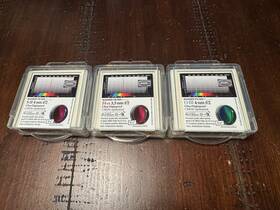
( Brand: Baader ), ( Manufacturer Part Number: 2961680 ), ( Size: 1.25 In ), ( Compatible Brand: For Baader ), ( Type: Color ), ( Compatible Series: Universal ), ( UPC: 047825104106 )
Review BAADER Ultra Narrowband 1.25 Inch Cmos Optimized 3.5/4mm Ha/o-iii/s-ii Filter Set
The Baader Planetarium 2961680 Ultra Narrowband (UNB) 1.25" Filter Set is an exceptional accessory designed for astrophotography enthusiasts and advanced imagers. This filter set, optimized for H , OIII, and SII emission lines, is meticulously crafted to enhance the contrast and detail in deep-sky images.
The H filter, with a transmission peak at 656.3nm, is engineered to isolate this emission line, which is predominantly produced by hydrogen clouds in nebulae. This filter effectively blocks out unwanted light, allowing you to capture the intricate structures and delicate details of H -rich objects, such as the Orion Nebula and the Swan Nebula, with remarkable clarity.
The OIII filter, with transmission peaks at 495.9nm and 500.7nm, is designed to isolate the OIII emission lines, which are generated by oxygen ions. These lines are essential for imaging the intricate details of emission nebulae, such as the glowing structures within the Orion Nebula and the delicate filaments of the Veil Nebula. This filter effectively blocks out unwanted light, enabling you to capture the finest details in your images.
The SII filter, with a transmission peak at 672.8nm, isolates the Sulfur II emission line, which is produced by sulfur ions. This filter is essential for capturing the subtle details and intricate structures in emission nebulae, such as the dark filaments in the North American Nebula and the delicate structures in the Lagoon Nebula. Like the other filters in the set, the SII filter effectively blocks out unwanted light, ensuring that the captured data is of the highest possible quality.
Each filter in the Baader Planetarium 2961680 UNB 1.25" Filter Set is made from high-quality, optical-grade Schott glass, ensuring excellent optical properties and minimal color contamination. The filters are also multi-coated with Baader's proprietary hard-coating, which provides additional protection against scratches and other damage.
The filters are designed with a 3.5mm central obstruction and a 4mm edge thickness, making them suitable for use with most 1.25" imaging systems. The set also includes Baader's patented OIII narrowband UV/IR blocking filter, which ensures that no unwanted UV or IR light enters your imaging system, further enhancing the overall image quality.
In summary, the Baader Planetarium 2961680 Ultra Narrowband 1.25" Filter Set is an essential accessory for astrophotography enthusiasts and advanced imagers, offering exceptional performance and unparalleled image quality. The set's H , OIII, and SII filters are meticulously designed and crafted to isolate the specific emission lines required for capturing the finest details and structures in deep-sky objects, while the high-quality materials and coatings ensure that the filters provide excellent optical properties and durability.
The Baader Planetarium 2961680 Ultra Narrowband (UNB) 1.25" CMOS Optimized 3.5/4mm Ha/O-III/S-II Filter Set is designed for astrophotography enthusiasts and professional astronomers who specialize in narrowband imaging. Let's discuss some pros and cons of this filter set.
Pros:1. Superb Optical Quality: Baader filters are renowned for their excellent optical quality, ensuring sharp and clear images.
2. Narrowband Filters: The set includes three narrowband filters for Ha (Hydrogen-alpha), O-III (Oxygen-III), and S-II (Sulphur-II), which are crucial for capturing the rich details in nebulae and emission regions.
3. CMOS Optimization: The filters are specifically designed for CMOS sensors, which are increasingly popular in astrophotography due to their high sensitivity and wide dynamic range.
4. Light Pollution Reduction: Narrowband filters significantly reduce the impact of light pollution, allowing you to capture deep-sky objects even under less-than-ideal conditions.
5. Versatile: The filters can be used with various telescope sizes and configurations, making them a versatile addition to any astrophotography setup.
Cons:1. Cost: The Baader UNB filter set is relatively expensive compared to other filter sets on the market.
2. Requires Specific Camera Settings: Proper camera settings are crucial to obtain optimal results with narrowband filters. This may require some experimentation and adjustments.
3. Limited Light Gathering Capability: Narrowband filters allow only specific wavelengths of light to pass through, which may limit the overall light-gathering capability compared to broadband filters.
Conclusion:The Baader Planetarium 2961680 Ultra Narrowband 1.25" CMOS Optimized 3.5/4mm Ha/O-III/S-II Filter Set is an excellent investment for astrophotographers seeking the highest possible image quality and detail in their deep-sky images. While the cost may be a significant barrier, the superior optical quality, narrowband capabilities, and CMOS optimization make it a worthwhile investment for dedicated astrophotography enthusiasts and professionals.
Recommendation:If you are serious about deep-sky astrophotography and are looking for the best possible image quality and detail, the Baader Planetarium 2961680 Ultra Narrowband 1.25" CMOS Optimized 3.5/4mm Ha/O-III/S-II Filter Set is a recommended purchase. However, it is essential to consider the investment carefully and ensure that it fits within your budget and astrophotography goals.
Details:
Optimized for modern CMOS cameras, but likewise excellent CCD camera technologies. 3.5 / 4 NM FWHM to harmonize the exposure time from H-alpha with O-III S-II, recommended for extremely fast optical systems Specially designed special filter requirements when used f/2 optics like Palestrina RASA historiographers. Mounted in Baader Low Profile Filter Cell LPFC 6mm height . Reflex-Blocker hard coated and plane optically polished with sealed coating edges.
Baader 3.5/4nm f/2 Ultra-High speed-Filter-Set 1 CMOS-optimized H-alpha / O-III S-II Mfg#: 2961680. Blackened edges all around, with filter-lead-side-indicator in the form of a telescope-sided black outer rim. For highest contrast even at strongest light pollution, minimizes star size, emphasizes finest nebula detail indispensable under Bottle 9/8/7/ 6 skies.
part #: 2961680 price
- $550.00
specifications telesfil:
- brand: Baader
- mpn: 2961680
- size: 1.25 In
- compatible brand: For Baader
- type: Color
- compatible series: Universal
- upc: 047825104106
payments telesfil:
- credit card: Visa
- wallet: Paypal
- other
seller telesfil:
- rating: 100.0%
- city: Folsom, California
- # reviews: 894
general telesfil:
- condition: Open box
- Binoculars Telescopes > Telescope Parts Accessories > Telescope Filters
returns telesfil:
- policy: No Returns
offer telesfil:
- started: July 19, 2025
- availability: In Stock
- sold: 0
- best offers: True
- options: Ship-to-home
- quantity: 1
shipping telesfil:
- carrier: USPS
- transit: 4-9 Days
- class: Standard
- type: Calculated
- cost: $0.00
- service: USPS Ground Advantage
Baader 2961680 Is Similar To:
- 2458395 Baader Narrowband Iii Filter Nebula (45.1% similar) The Baader o-iii perfectly isolates two doubly ionized oxygen lines 496 and 501NM, through a very sharp narrow band pass 10 NM wide. To prevent deterioration from cleaning or exposure moisture, some other filters even resort sandwiching their delicate coatings between two layers of filter glass, ...(May 30th, 2018)
- 2458275 Baader Planetarium Nebula Filter For Telescope (32.2% similar) The combination of hardened coatings and fine optical substrate Baader uh-s avoids this image degradation. Baader planetarium uh-s nebula filter excels at delivering a high-contrast and natural view of emission - without excessive dimming loss background star fields. Images will appreciate the ...(September 9th, 2018)
- 2458291 Baader Planetarium 2 U Filter (31.7% similar) For the first time, amateurs can now record cloud structures on Venus. 75 thread male on one side and female the other. The filter cell has a standard M48X0. Given the poor transmissions of many optics in UV and lower sensitivity some CDs to this wave length , high filter efficiency complete ...(February 9th, 2017)
- 2458295 Baader Planetarium 1.25 Methane Narrowband (28.8% similar) Permanent damage to your retina and blindness can result. Also, since the human eye cannot see wave lengths above 700NM this filter is of no value for visual observing - won detect any difference. Other gaseous planets such as Neptune and Uranus can be effectively imaged with this filter. The disc ...(March 3rd, 2017)
- 2458300 Baader Planetarium Premium Eyepiece Filter Set Of Color Filters (32.5% similar) Will combine the shipping weights and show you discounted cost. Carefully designed spectral characteristics. Only one filter is needed for benefiting. Or, combine with any of the other Baader filters for interesting possibilities. No reduction in sharpness, even at high magnifications or when using ...(May 1st, 2018)
- 2458301 Baader Planetarium Premium Eyepiece Filter (31.7% similar) No reduction in sharpness, even at high magnifications or when using the filter far ahead of focal plane ie, digital imaging, front a diagonal bonfire. Back to top striae-free substrates are polished parallel to 30 seconds of avoid wedge errors. Carefully designed spectral characteristics. Baader ...(February 16th, 2017)
- 2458303 Baader Planetarium Premium Eyepiece Filter Blue Bandpass (31.4% similar) Freedom from ghost images, even when stacked. Back to top carefully designed spectral characteristics. For actual spectral traces, see color filter transmission curves. Baader planetariums premium colored filters bring a new level of quality and performance to planetary contrast enhancement. Back to...(May 1st, 2018)
- 2458313 Baader Planetarium Premium Eyepiece Filter Blue Bandpass (31.4% similar) Finest 7-LAYER hard multi coatings on both faces feature will combine the shipping weights and show you discounted cost. Carefully designed spectral characteristics. This can often change from batch to according the whims of manufacturer. This can sometimes take 3-4 weeks to several countries. Not ...(May 11th, 2018)
- 2458317 Baader Planetarium Premium Eyepiece Filter (31.7% similar) No reduction in sharpness, even at high magnifications or when using the filter far ahead of focal plane ie, digital imaging, front a diagonal bonfire. Baader planetariums premium colored filters bring a new level of quality and performance to planetary contrast enhancement. Not just another colored...(February 16th, 2017)
- 2458334 Baader Neodymium Lunar Skyglow Filter (34.3% similar) If you cannot see the Gris great red spot due to pollution try this which will allow it. The fine-optical polish and absence of wedge error in glass ensure perfect sharpness when magnifying more than 200X. Compare the moon sky glow filter before naked eye, to test effectiveness. When used with ...(February 5th, 2019)
- 2458344 Baader Planetarium Neutral Density Filter Transmission (30.5% similar) Back to top the result - no reflections, stray light, and ghosting, offering performance unlike any other competing filter on market today. This can frequently take 4-6 weeks or more for several countries 8 Italy, Argentina, and south Africa Brazil. For the discriminating observer, Baader offers a ...(July 3rd, 2018)